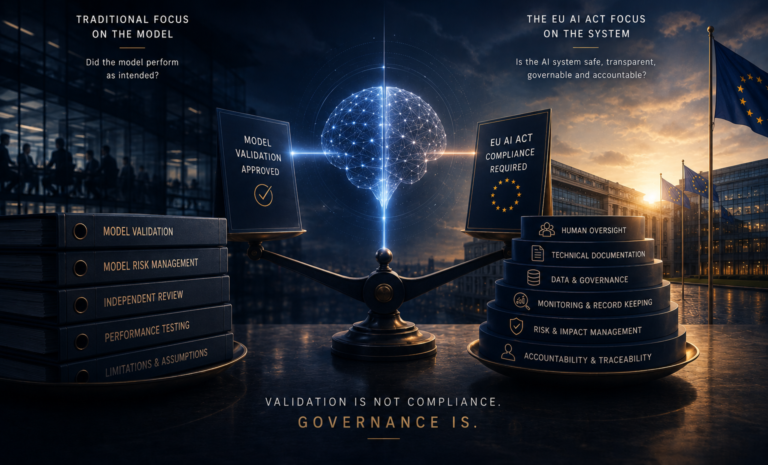
Many financial institutions are making a dangerous assumption about the governance of their AI deployments. The model passed validation. The Model Risk Management team signed off. The governance committee approved deployment. The conclusion that often follows is that the organisation is reasonably aligned to its regulatory obligations.
It is an understandable assumption. For more than a decade, Model Risk Management frameworks have been the dominant governance discipline for models across financial services. Institutions have invested heavily in model inventories, validation capabilities, independent review functions, and governance processes designed to ensure models are performing as intended. When a model passes validation, there is a reasonable expectation that its methodology has been assessed, its performance tested, and its limitations documented. The challenge is that the EU AI Act is asking a different question.
While traditional model governance focuses on the model itself, the Act is concerned with the behaviour of the AI system as a whole. It extends beyond algorithms and methodologies to include data flows, operational processes, human oversight arrangements, accountability structures, monitoring activities, technical documentation, record keeping, and the impact of decisions on the individuals affected by those systems. That distinction may become one of the most consequential governance challenges facing financial institutions over the next few years. Many organisations have mature frameworks for validating models. Far fewer have developed equally mature frameworks for governing AI systems.
The Shift Most Governance Frameworks Have Not Yet Made
The difference between a model and a system may appear subtle, but it fundamentally changes the governance conversation. Model Risk Management has traditionally focused on questions such as whether a model performs as intended, whether assumptions are appropriate, whether limitations are understood, and whether performance remains within acceptable thresholds. These remain important questions, and there is nothing within the EU AI Act that diminishes the value of robust model governance.
The Act, however, moves the conversation beyond model performance and into operational accountability. It asks whether the organisation can demonstrate that an AI system remains safe, transparent, governable, and appropriately controlled throughout its lifecycle. It is concerned not only with how a model behaves in testing, but also with how the broader system functions once deployed into real business processes involving customers, employees, third parties, and regulators.
This distinction matters because a model can be technically robust, statistically sound, and fully approved under existing Model Risk Management frameworks while the wider deployment environment remains non-compliant with the Act. The model itself may perform exactly as intended, yet the organisation may be unable to demonstrate sufficient human oversight, maintain the required operational documentation, evidence ongoing monitoring, retain appropriate records, or clearly assign accountability for outcomes generated by the system.
In many institutions, the governance structures required to answer these questions are still evolving. As a result, organisations that consider themselves mature from a model governance perspective may discover that their AI governance maturity is less advanced than they initially assumed.
Why This Creates a New Category of Enterprise Risk
The significance of the EU AI Act extends beyond compliance. It introduces a category of enterprise risk that sits across existing control functions rather than neatly within them. Consider accountability. In most financial institutions, model risk teams govern methodology and validation, compliance teams interpret regulatory obligations, technology teams manage infrastructure, data teams oversee information assets, and product teams make deployment decisions. Each function performs an important role. Yet the Act governs the behaviour of the AI system as a whole. Consequently, organisations may discover that responsibility for individual components is well understood while accountability for the end-to-end system remains fragmented.
A similar challenge emerges from an operational risk perspective. AI systems do not remain static after deployment. Data changes, user behaviour evolves, monitoring thresholds are adjusted, and operating environments shift over time. A model may continue to perform within acceptable parameters while the controls surrounding its use gradually weaken. The governance challenge therefore becomes less about validating a point-in-time outcome and more about demonstrating continuous oversight throughout the operational lifecycle of the system.
The same pattern can be observed across conduct risk, regulatory risk, and reputational risk. The Act requires organisations to consider not only whether a system functions correctly, but whether the outcomes it produces can be explained, challenged, governed, and defended. Increasingly, the question regulators and stakeholders are asking is not whether the model passed validation. It is whether the institution can explain what happened, who was accountable, what controls were in place, and how potential harm was identified and addressed. This is fundamentally a governance challenge rather than a technology challenge.
The Governance Capabilities the EU AI Act Requires
The EU AI Act has been implemented in phases since February 2025, with most remaining provisions scheduled to apply from August 2026. While implementation timelines have continued to evolve through policy discussion and legislative refinement, the substance of the high-risk obligations remains significant.
For financial institutions, two categories within Annex III are particularly relevant. These include AI systems used to evaluate the creditworthiness of natural persons or establish their credit score, as well as AI systems used for risk assessment and pricing in relation to natural persons in life and health insurance. Organisations deploying AI within these activities need to look carefully at the high-risk AI system obligations and the related deployer obligations that apply to them.
The point that risk leaders should not miss is that the core requirements for high-risk AI systems are not limited to validation. Articles 9 to 15 set out a broader governance architecture covering risk management, data governance, technical documentation, record keeping, transparency, human oversight, and system performance. Each of these areas touches an existing control function, but none of them can be satisfied by a model validation report alone.
Article 9 requires a risk management system for high-risk AI systems. This is not a single approval event. It requires an iterative and continuous process that identifies, estimates, evaluates, and mitigates risks throughout the lifecycle of the system. For institutions used to validation gates and periodic model reviews, this is a meaningful shift. The evidence question becomes whether risk management remains active after deployment and whether the institution can show that risks are monitored as the system, data, users, and operating environment change.
Article 10 addresses data and data governance. This matters because many AI failures are not caused by the model methodology alone, but by weaknesses in the data that feeds, trains, tests, or operates the system. For financial institutions, this connects directly to lineage, quality, representativeness, bias, relevance, and the controls applied to data used in high-risk decision-making. A model may be validated using a controlled dataset, but compliance exposure can still arise if live data flows, data drift, or operational data quality are not governed properly.
Article 11 requires technical documentation. This is an area where many organisations may underestimate the gap. Technical documentation under the Act is not simply an internal design note or a model validation pack. It needs to support regulatory inspection, demonstrate compliance with the relevant requirements, and explain the system in a way that allows its purpose, design, assumptions, limitations, and controls to be understood. For complex organisations, this becomes a documentation operating model question rather than a document production task.
Article 12 requires record keeping, including the automatic recording of events, commonly described as logging. This is one of the clearest examples of where AI Act readiness becomes operational. If a serious incident occurs, or if a decision is challenged, the institution needs to be able to reconstruct how the system operated, what inputs were relevant, what outputs were produced, and what human or system actions followed. Without appropriate logging and retention arrangements, accountability becomes difficult to evidence after the fact.
Article 13 addresses transparency and the provision of information to deployers. In practice, this means the people and functions using the system must be able to understand its intended purpose, limitations, expected performance, and appropriate conditions of use. Transparency is therefore not only a technical explanation of how a model works. It is an operational capability that supports correct use, effective challenge, and informed decision-making by the people relying on the system.
Article 14 sets out the requirement for human oversight. This is perhaps one of the most demanding areas for financial institutions because it tests whether oversight exists in substance rather than only in process design. The Act requires more than simply placing a human somewhere in the workflow. Individuals responsible for oversight must have the competence, authority, and support to understand the system, interpret outputs, recognise the risk of automation bias, and intervene where necessary. Many organisations have governance structures that imply human oversight exists, but considerably fewer can evidence that oversight in a way that would withstand regulatory scrutiny.
Article 15 covers accuracy, robustness, and cybersecurity. This is an important bridge between model risk, technology risk, and operational resilience. The system needs to perform at an appropriate level of accuracy, remain resilient under reasonably foreseeable conditions, and be protected against vulnerabilities that could affect its behaviour or outputs. In financial services, this connects AI governance directly to technology controls, resilience, change management, incident response, and cyber risk oversight.
Taken together, Articles 9 to 15 show why EU AI Act compliance cannot be reduced to a model validation exercise. They require an operating model that joins together model governance, data governance, technology controls, operational risk, compliance oversight, human decision-making, and auditability.
The Deployer Obligations Risk Leaders Cannot Ignore
The distinction between provider obligations and deployer obligations is especially important for financial institutions. Many firms will procure AI-enabled systems from vendors and may assume that supplier compliance materially reduces their own exposure. It may reduce some risks, but it does not remove the obligations that sit directly with the institution using the system.
Article 26 places obligations on deployers of high-risk AI systems. This includes using the system in accordance with the instructions for use, assigning human oversight to people with the necessary competence, training, authority and support, monitoring the operation of the system, keeping relevant logs where they are under the deployer’s control, and taking action where there is reason to consider that use of the system may present a risk. In practice, this means vendor assurance is necessary but insufficient. The institution still needs its own governance arrangements for how the system is used, overseen, monitored, and escalated once deployed in its operating environment.
This matters because many AI governance gaps emerge not during procurement, but after deployment. A vendor may provide a technically capable system and supporting documentation, but the institution remains responsible for ensuring the system is used appropriately within its own processes, by its own staff, for its own intended purpose, under its own risk appetite. That is not a contractual formality. It is an operating model responsibility.
The Fundamental Rights Impact Assessment Gap
One of the most significant additions introduced by the Act is the requirement for a Fundamental Rights Impact Assessment in certain high-risk use cases under Article 27. This introduces a governance lens that many financial institutions have historically not applied in a structured way.
A Fundamental Rights Impact Assessment is not a model validation exercise, nor is it simply an extension of a data protection assessment. It requires organisations to evaluate the potential impact of an AI system on the rights of affected individuals, including considerations relating to discrimination, fairness, dignity, access to services, and access to redress. In the financial services context, this is particularly relevant where AI is used in creditworthiness assessment, credit scoring, and certain insurance risk assessment or pricing activities.
Many models currently operating in production environments have undergone extensive validation, performance testing, and compliance review without ever being assessed through this perspective. That does not mean those models are necessarily harmful, but it does mean that institutions may not yet have the evidence base required to demonstrate that the broader system has been assessed through the lens the Act requires.
The Fundamental Rights Impact Assessment requirement illustrates why AI Act compliance cannot be determined solely through existing Model Risk Management frameworks. A model can satisfy internal performance standards and still raise questions about how outcomes affect individuals, how decisions can be challenged, and whether oversight is meaningful in practice.
The Gap Between Validation and Accountability
The most significant difference between traditional model governance and EU AI Act compliance is not technical. It is organisational.
Model validation seeks to establish whether a model performs as intended and whether its limitations are understood. The Act asks whether the organisation can demonstrate responsible deployment, effective oversight, transparent operation, clear accountability, appropriate records, sufficient technical documentation, and protection of the individuals affected by the system.
These questions are related, but they are not interchangeable.
Many institutions have invested heavily in validating models. Far fewer have invested in governing the organisational behaviour that emerges once those models become embedded within operational processes. Yet this is where many of the most significant risks arise. The governance challenge is not simply whether an AI system works. It is whether the institution can continue to explain accountability once humans begin relying on that system operationally.
This distinction is particularly important because accountability becomes more difficult to trace as AI systems become integrated into business processes. Decisions may be influenced by multiple models, multiple data sources, multiple technology platforms, and multiple human actors. Without a governance framework designed specifically for AI systems, institutions may struggle to demonstrate where responsibility begins, where it ends, and how oversight is maintained throughout the process.
What Risk Committees Should Be Asking
As institutions assess their readiness for the EU AI Act, the most productive conversations are often those that move beyond regulatory interpretation and focus instead on governance effectiveness.
The first question is whether the organisation has clearly distinguished between model validation and EU AI Act compliance. A validated model may still operate within a deployment environment that fails to satisfy requirements under Articles 9 to 15, particularly in relation to lifecycle risk management, technical documentation, logging, transparency, human oversight, and system robustness.
The second question concerns ownership. Has end-to-end accountability been established for high-risk AI systems, or is responsibility fragmented across multiple functions with no single point of ownership for how the system behaves in production?
The third question is whether meaningful human oversight can be evidenced. Organisations should be able to demonstrate not only that humans participate in the process, but that they possess the capability, authority, and information necessary to challenge system outputs when appropriate.
The fourth question is whether deployer obligations under Article 26 have been translated into practical operating controls. This includes oversight assignment, monitoring arrangements, instructions for use, escalation routes, incident handling, and log retention where applicable.
The fifth question is whether high-risk systems have been assessed through all relevant regulatory lenses, including where a Fundamental Rights Impact Assessment under Article 27 may be required.
Finally, institutions should consider whether their controls operate continuously throughout the lifecycle of the system or whether governance remains concentrated around approval activities and validation checkpoints. The Act places considerable emphasis on ongoing oversight, and organisations that rely primarily on point-in-time reviews may find themselves exposed.
The Strategic Reality
Recent adjustments to implementation timelines have created a perception in some organisations that there is more time available than initially anticipated. While that may be true from a scheduling perspective, it does not reduce the scale of the work required.
Building an AI governance operating model capable of supporting regulatory obligations, operational accountability, meaningful human oversight, continuous monitoring, technical documentation, record keeping, and defensible decision-making is not a short-term exercise. These capabilities require coordination across risk, compliance, technology, data, product, procurement, legal, and business functions. They cannot be created through policy documentation alone.
Institutions that review their existing Model Risk Management framework and conclude that they are largely aligned to the EU AI Act may find they have answered the wrong question. The fact that a model has passed validation remains important. It demonstrates that the methodology has been assessed, performance has been tested, and limitations have been documented. However, compliance under the Act requires organisations to demonstrate a broader set of capabilities that extend beyond the model itself into the governance of the system as a whole.
Over the next few years, AI governance maturity is unlikely to be measured solely by the sophistication of models or the strength of validation frameworks. Increasingly, it will be measured by an institution’s ability to evidence accountable deployment, continuous oversight, meaningful human control, reliable records, transparent operation, and governance that remains visible long after a model enters production.
The organisations that recognise this distinction early will do more than reduce their regulatory exposure. They will build something that is becoming increasingly valuable in an AI-enabled economy: institutional trust grounded in demonstrable governance.