Every merger begins with optimism. There is a deal thesis, a synergy model, board approval, and usually a compelling narrative about growth, scale, capability, or market position. Yet the point at which many integrations begin to fail is not in the negotiation room. It is in the months and years that follow, when two organisations are expected to become one.
This is where the Target Operating Model, or TOM, becomes decisive.
In financial services especially, post-merger integration is not simply a restructuring exercise. It is the rebuilding of an institution while that institution continues to operate under regulatory scrutiny, client expectation, market pressure, and internal uncertainty. The organisations that succeed are rarely the ones with the most ambitious deal thesis. They are the ones that treat operating model design as a strategic discipline rather than an implementation detail.
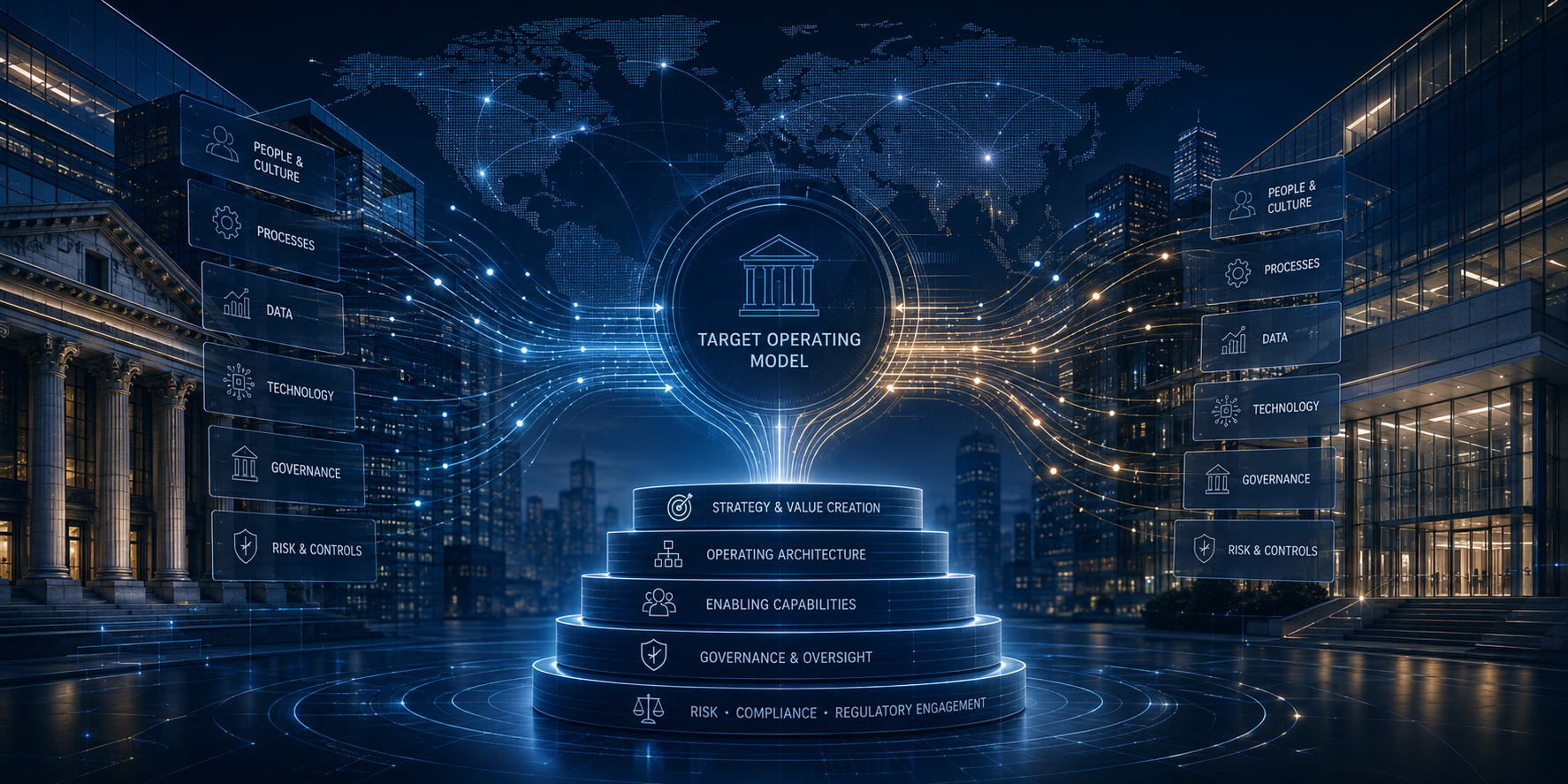
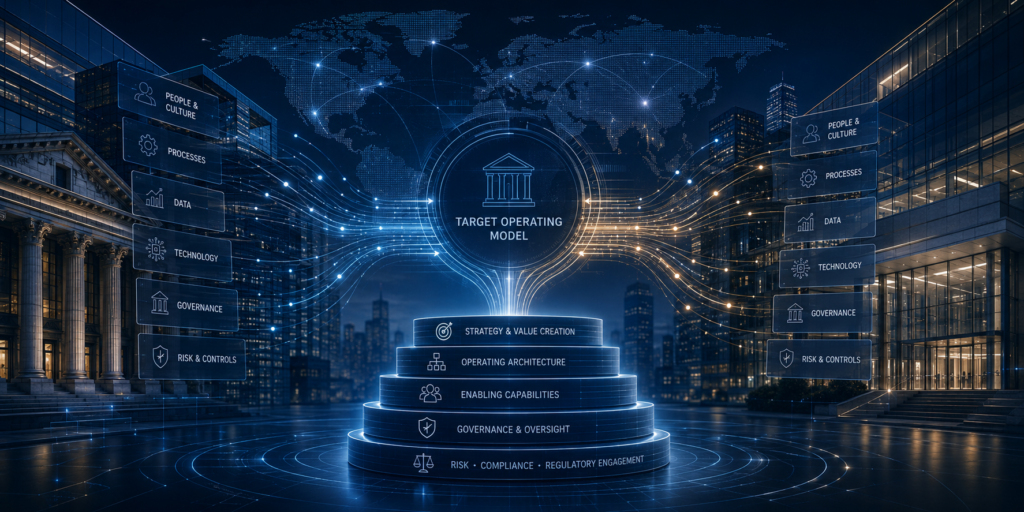
A TOM is not an ordinary slide deck. It is the operational architecture of the combined entity. It determines how decisions are made, how risk is governed, how processes flow, how data is managed, how technology supports the business, and how people work together after the transaction closes. Most importantly, it determines whether the value promised by the deal can actually be realised.
Why Integrations Fail
The most common integration failure is not the absence of a Target Operating Model. It is the presence of one that was designed for the transaction rather than for the organisation that must eventually operate.
Many TOMs look coherent in presentations but collapse under operational reality. They are built on optimistic technology assumptions, vague governance structures, and cultural compromises that avoid difficult decisions instead of resolving them. A TOM that cannot survive contact with the organisation it is meant to govern is not a real operating model. It is a statement of intent.
The challenge becomes even more pronounced in global financial services, where integrations involve multiple jurisdictions, competing regulatory expectations, legacy technology environments, and institutions with fundamentally different cultures and risk appetites. Over time, one pattern becomes consistently clear: integrations succeed or fail based on the quality of execution across a set of deeply interconnected operational disciplines.
The Nine Pillars That Determine Integration Success
A workable TOM rests on nine interdependent pillars. None operates independently. Weakness in one pillar creates pressure across the others:
- Culture
- People
- Stakeholder Management
- Process
- Data
- Technology
- Governance
- Controls and Regulatory Engagement
- Change Management
1. Culture Shapes Everything Else
Culture is often treated as a secondary issue in integration programmes. In reality, it is the medium through which every other part of the operating model is delivered. Technology migrations, governance frameworks, reporting structures, and process redesigns are all implemented through people whose behaviours are shaped by institutional history and cultural norms.
This becomes particularly difficult when institutions with fundamentally different operating philosophies combine. Relationship-driven private banks and transaction-led retail institutions, for example, may appear operationally compatible while holding entirely different assumptions about decision-making, client ownership, risk, and accountability.
One of the most damaging mistakes leadership teams make is treating culture as a communications exercise. Culture is not shaped by town halls or values statements alone. It is shaped by incentives, escalation mechanisms, performance measures, and what leadership rewards or tolerates in practice.
In cross-border integrations, these tensions become even more visible. Different jurisdictions often carry different assumptions about hierarchy, authority, communication style, and regulatory engagement. Ignoring those differences does not remove them. It simply pushes dysfunction below the surface.
2. The Human Problem is Larger Than Most Models Assume
Every merger document discusses talent retention. Almost every one underestimates the scale of the challenge. The moment a transaction is announced, uncertainty enters the organisation. The people most critical to integration delivery are often the most employable externally. At the same time, employees begin making informal judgements about dealing with existential threats. That perception changes behaviour quickly. People become cautious with information, protective of relationships, and less collaborative. Integration momentum slows long before formal organisational changes are made.
This is why people decisions cannot wait for the final operating model. Leadership appointments, role clarity, and visible meritocracy must happen early. Organisations need evidence that capability, not institutional legacy, will determine the future structure.
Role alignment also requires far more rigour than most programmes anticipate. Two individuals may hold identical titles in different institutions while operating under completely different behavioural expectations, performance standards, and decision rights. Without explicit reconciliation of those differences, conflict is inevitable.
3. Stakeholder Management is a Strategic Discipline
Large-scale integrations involve far more than executive leadership teams.
Boards, regulators, institutional clients, rating agencies, unions, employees, and markets all become active stakeholders in the success or failure of the programme. Each group carries different priorities, different concerns, and different definitions of success. One communication strategy cannot serve all of them.
The political dimension inside the organisation is equally important. Senior leadership teams from both institutions are navigating uncertainty while protecting influence, reputation, and legacy. Informal networks often carry more operational power than formal governance charts suggest. The most dangerous stakeholder in any integration is the senior executive who has privately disengaged from the programme but remains publicly aligned.
Successful integration leaders maintain visibility not only into formal governance structures, but also into the informal political landscape shaping organisational behaviour beneath them.
4. Regulation is Not a Workstream. It is a Design Constraint.
In financial services, regulators are not observers of integration. They are active participants. Cross-border combinations may involve multiple supervisory authorities operating under different legal frameworks and resolution regimes. Decisions made for one regulator can easily create complications with another.
This is particularly important in the current environment, where operational resilience expectations have become significantly more demanding. Frameworks such as the EU’s Digital Operational Resilience Act (DORA), alongside heightened resilience expectations from regulators in the UK and elsewhere, mean integrations must demonstrate continuity of critical services throughout transition periods. Regulators have shown increasing willingness to challenge or delay integration activity where resilience cannot be adequately evidenced.
The lesson is this: engage regulators early, transparently, and continuously. Regulatory surprises during integration are almost always more expensive than the underlying issues themselves.
5. Process and Data are Where Complexity Becomes Real
Process design is frequently oversimplified during integrations. On paper, rationalising workflows appears manageable. In practice, institutions carry years of undocumented workarounds, manual interventions, compensating controls, and informal dependencies that only become visible during implementation. This ‘process debt’ is one of the hidden liabilities of integration.
The same is true of data. Every large financial institution has legacy data challenges. Client records, product taxonomies, entity hierarchies, and reporting structures have usually evolved over decades across multiple systems and acquisitions. When two institutions combine, those issues compound rather than disappear.
The critical question is not whether duplicate records exist. It is whose data becomes authoritative, how governance decisions will be made, and who has the authority to resolve conflicts when they emerge. Data governance during integration cannot operate as a secondary project workstream. It must function as core infrastructure with executive authority and clear ownership.
6. Technology Sets The Pace of Integration
Technology integration is almost always the longest and least controllable component of a TOM. There are generally three choices available: adopt the acquirer’s platform, adopt the target’s platform, or build a new environment. None is simultaneously low-risk, fast, and inexpensive.
Yet many programmes still underestimate technical debt, undocumented dependencies, and migration complexity during early planning. Technology discovery routinely reveals additional complexity after deal close. The issue is not whether surprises will emerge, but whether the programme has sufficient governance, budget flexibility, and sequencing discipline to absorb them.
This is why timelines should never be fixed before meaningful technical discovery is complete. A compressed discovery phase may accelerate early momentum, but it often creates far more expensive delays later in the programme.
7. Governance Only Works if Decisions Can Actually be Made
Governance is the architecture of accountability. In a merged institution, it is one of the most politically charged components of the TOM because it determines, in concrete terms, who has authority, who has influence, and who has neither.
Governance diagrams are easy to produce. Effective governance is far harder. The real test of governance is operational clarity. For every material decision, the organisation should know:
- who decides
- with what information
- under what timeframe
- and what happens if agreement cannot be reached
If those answers are unclear, governance is incomplete.
This can be especially difficult in multi-jurisdictional structures where legal, regulatory, and cultural expectations differ significantly. Governance models that appear coherent structurally often require continuous maintenance to function effectively in practice.
8. Controls and Regulation Cannot be Treated Separately
In financial services integrations, controls and regulatory engagement are not supporting functions sitting alongside the operating model. They are structural constraints that shape the operating model itself. Every institution enters a merger with its own control environment, risk appetite, compliance framework, audit methodology, and regulatory history. The challenge is not simply combining these frameworks. It is building a single control architecture that satisfies regulators, supports the combined risk profile, and remains operationally workable under real business conditions.
One of the most common early mistakes is attempting to run both legacy control environments in parallel for too long. On the surface, this appears safer. In practice, it creates duplication, blurred accountability, and dangerous coverage gaps where each framework assumes the other is managing the risk.
A workable TOM must establish a single, coherent control framework for the combined entity. That means making explicit decisions about standards, escalation routes, risk ownership, and regulatory reporting obligations across jurisdictions.
9. Change Management is Not Optional
Many integration programmes still treat change management as a soft discipline attached to a hard transformation programme. That is a mistake. Large-scale integrations create sustained organisational stress. Employees are expected to absorb new reporting lines, new systems, new leadership structures, new processes, and new cultural expectations while continuing to operate the business. The organisation’s capacity to absorb change is finite. When programmes exceed that capacity, integration quality deteriorates rapidly. Resistance increases, talent exits accelerate, operational incidents rise, and momentum weakens.
Strong change management requires disciplined communication, visible leadership alignment, active resistance management, and clear adoption tracking. Silence rarely creates stability during integration. More often, it creates rumours that are worse than reality.
Phasing and the First 100 Days Determine the Trajectory of the Integration
One of the most damaging misconceptions in post-merger integration is the belief that integration is a single event. It is not. It is a multi-year sequence of operational, structural, regulatory, and cultural transitions that must be managed with discipline and precision. In complex financial services integrations, particularly cross-border combinations, the programme often unfolds over three to five years. Different stages require different leadership behaviours, different governance priorities, and different tolerances for risk and change. Organisations that fail to recognise this usually attempt to accelerate structural transformation before the institution is stable enough to absorb it.
A successful integration generally moves through three distinct phases: stabilisation, integration, and optimisation.
Phase one, stabilisation, runs from day one to approximately the end of the first year. Its primary objective is to prevent value destruction while the integration is designed. This means maintaining operational continuity, managing client relationships through the uncertainty of the announcement period, retaining key talent, and establishing the governance infrastructure through which the integration will be managed. It does not mean beginning the structural changes that the TOM requires. The instinct to move quickly into operating model changes before the design is complete, before the discovery work is finished, and before the governance is functional is the source of a significant proportion of integration failures.
Phase two, integration, is where the TOM is implemented. Technology platforms are migrated, processes are rationalised, governance structures are established, and the people organisation is restructured. This phase is typically the most operationally intensive and the most politically charged, because it is the phase in which the structural implications of the deal are made concrete and personal for the people affected.
Phase three, optimisation, begins when the combined entity is structurally stable and focuses on realising the capabilities and efficiencies that the combination was designed to create. This is the phase in which the synergy model begins to deliver, and it requires less crisis management and more strategic development in leadership.
Within this broader timeline, the first 100 days carry major importance and strategic weight. Decisions made in those early days shape organisational confidence in the integration long before the deeper structural work begins. Leadership appointments send immediate signals about whether the new institution will operate meritocratically or politically. Governance structures established at this stage determine whether the programme will function with accountability or drift into ambiguity. Early engagement with regulators and key clients influences trust levels that may take years to rebuild if damaged. Perhaps most importantly, communication during the first 100 days establishes the emotional tone of the integration.
Employees do not expect leadership to have every answer immediately. What they do expect is honesty, clarity of direction, and visible command of the process. Organisations that communicate carefully but transparently during periods of uncertainty retain far more trust than those that attempt to manage anxiety through silence.
The first 100 days do not complete the integration. They create the conditions under which the integration will either gain credibility or begin losing it.
A TOM is How The Deal Thesis Becomes Reality
Every acquisition is supported by a synergy model. The Target Operating Model is the mechanism through which those synergies are either delivered or lost.
Cost synergies require technology consolidation, process rationalisation, governance simplification, and organisational restructuring to happen on credible timelines. Revenue synergies require integrated client architecture, aligned capability models, and cultural cohesion.
When integration programmes drift, synergy assumptions erode quickly. Additional technology spend, extended dual-running costs, retention arrangements, and regulatory remediation all weaken the economics originally presented to boards and shareholders.
In many failed integrations, the problem was not the strategic rationale behind the deal. It was the disconnect between the synergy assumptions and the operating model designed to support them. The synergy model assumed cost savings that the TOM design did not in fact enable. This is a design failure, and it is avoidable.
What Good Integration Actually Looks Like
Strong integrations share a few consistent characteristics. They begin with honest discovery rather than optimistic assumptions. They prioritise sequencing over artificial speed. They make difficult decisions explicitly instead of managing them through ambiguity. And at critical moments, they rely on visible leadership willing to make difficult calls clearly and decisively.
Ultimately, a Target Operating Model is not simply an operational framework. It is a statement about what the combined institution intends to become. The organisations that succeed are not necessarily those with the largest transactions or the most ambitious strategic narratives. They are the ones willing to invest in the sustained, disciplined work required to turn two institutions into one coherent organisation.
That work is rarely glamorous. It is often politically difficult, operationally exhausting, and structurally complex. But in global financial services, it is the work that determines whether a merger creates lasting value or becomes another expensive lesson in integration failure.