
Enterprise artificial intelligence is entering a new phase. For the past two years, the race has largely been about capability. Model providers competed to deliver larger context windows, stronger reasoning and increasingly impressive benchmark results. Today, however, the conversation is beginning to shift. As foundational models become more capable and performance differences narrow, attention is moving towards a different question: how efficiently can intelligence be delivered?
This shift is reflected in the economics of the market. Investors are no longer rewarding capability alone; they are rewarding the ability to deliver intelligence at scale and at sustainable cost. As agentic workflows become more common, token efficiency is emerging as a critical operational metric.
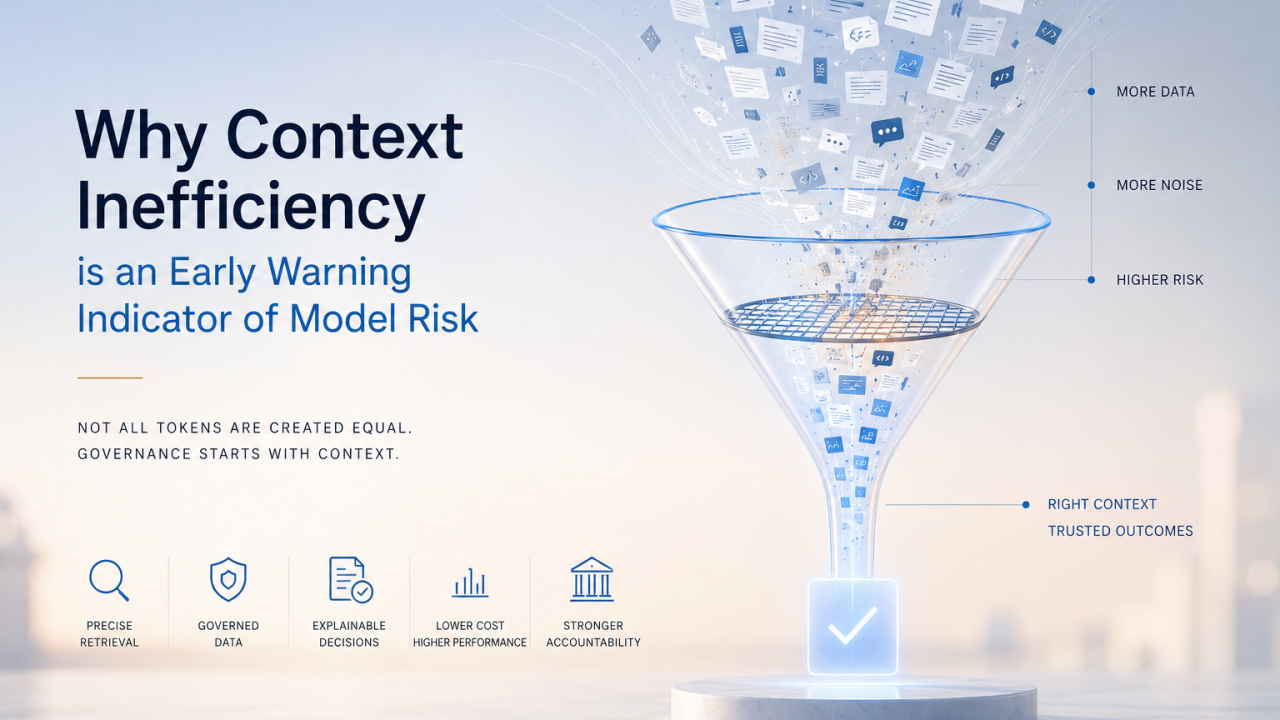
Yet many organisations continue to view excessive token consumption primarily as a technology cost issue. That perspective is incomplete. What often appears as token inefficiency is, in reality, context inefficiency. More importantly, it can be an early warning indicator of model risk.
The Hidden Cost of Context
Every interaction with a large language model consumes tokens. While users see only a prompt and a response, the majority of token consumption is often generated by the surrounding context: system instructions, retrieved documents, chat history, tool definitions, execution traces and supporting data.
In many enterprise deployments, the largest share of compute is not spent reasoning. It is spent moving context through increasingly complex orchestration layers. When retrieval mechanisms are weak or information architecture is poorly designed, systems compensate by supplying more data. Thousands of additional tokens are introduced in the hope that the model will eventually find the relevant signal.
The immediate consequence is higher cost. The more significant consequence is that the model is forced to reason over increasing volumes of irrelevant, conflicting or poorly governed information.
From Efficiency Problem to Governance Problem
The discussion around token usage is often framed as an engineering challenge. Organisations focus on reducing inference costs, improving response times and optimising infrastructure. Those benefits matter, but they are not the primary concern. The more important question is whether an organisation can maintain accountability when the context supplied to a model becomes increasingly difficult to govern.
Context inefficiency is frequently the first observable symptom of deeper weaknesses in retrieval controls, data lineage, evidence traceability and information governance. When a model is presented with excessive or poorly curated information, it may still produce a plausible answer, but the reliability of the decision pathway becomes increasingly uncertain.
This is why context inefficiency should not be viewed as a technical optimisation issue alone. It is often an indicator that governance controls are failing upstream.
The Risks Hidden Beneath Context Bloat
As context layers expand, so does the risk profile of the system. Models operating within large volumes of loosely governed information become more susceptible to hallucinations, inconsistent outputs, bias and unpredictable decision making. Excessive context can dilute signal quality rather than improve it. The challenge becomes particularly acute in regulated environments.
Many organisations attempt to compensate for weak information architecture by providing the model with more data. While this may improve short-term output quality, it often masks underlying governance debt. The model receives large quantities of information without sufficient control over relevance, provenance, ownership or quality. The result is a gradual erosion of explainability.
When thousands of retrieved tokens contribute to an outcome, organisations may struggle to explain which specific evidence materially influenced the decision. The audit trail becomes harder to reconstruct, and explainability begins to deteriorate long before accuracy metrics reveal a problem. For organisations operating under regulatory scrutiny, that should be a concern.
Governing the Context Layer
The solution is not simply to reduce token consumption. The objective is to govern context with greater precision.
Organisations should treat context as a governed asset rather than an unlimited resource. Models should be supplied with the smallest relevant evidence set required to perform a task effectively. Retrieval mechanisms must prioritise precision over volume, while information architecture should remove noise before it reaches the reasoning engine.
Most importantly, governance frameworks should explicitly recognise context management as a control discipline. Ownership, evidence traceability, retrieval quality and information lineage should be subject to the same rigour applied to model performance, resilience and bias monitoring. Viewed through this lens, context efficiency becomes more than a cost metric. It becomes a measure of governance maturity.
A Test of Accountability
Managing context efficiently is not ultimately a cost optimisation exercise. It is a test of accountability. Organisations that govern context effectively are not simply reducing infrastructure expenditure. They are strengthening explainability, preserving auditability and improving confidence in AI-driven decisions.
As enterprise AI moves from experimentation into critical business operations, the winners will not necessarily be those with the largest models or the widest context windows. They will be the organisations that can deliver the right intelligence, supported by the right evidence, at the right cost, while maintaining a defensible audit trail.
In the next generation of agentic systems, context discipline may prove just as important as model capability itself.